National Neuroscience Institute will NEVER ask you to transfer money over a call. If in doubt, call the 24/7 ScamShield helpline at 1799, or visit the ScamShield website at www.scamshield.gov.sg.
Staying awake during spine surgery can be a safer treatment option for the elderly
11 Jul 2026 | The Straits Times
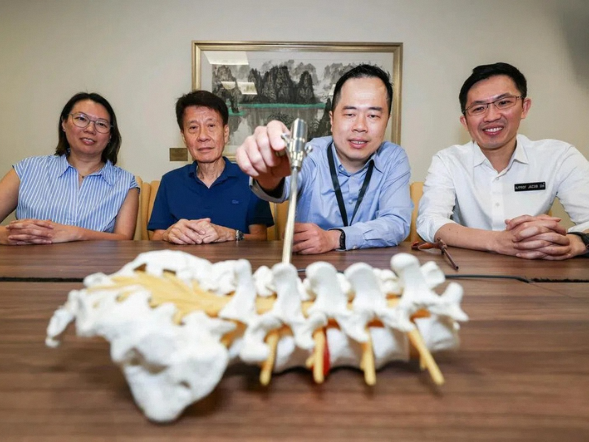
Thomas Tan (third from left), a consultant neurosurgeon at the National Neuroscience Institute, demonstrating where specialised instruments access the spine while minimising damage to surrounding tissues. ST PHOTO: BRIAN TEO
By Judith Tan
SINGAPORE – He loved running through the park every evening and ballroom dancing, but a pinched nerve in his lower back put a complete stop to these activities for Teo Seow Heong.
“The pain started in my lower back, and then my left leg became numb. It did not feel like that was my leg,” said the retired precision engineer, 75.
“When my family and I went on a holiday in Thailand, I had difficulty walking.”
The first doctor Teo consulted referred him to a physiotherapist, who said he needed to exercise and stretch.
“It did not work at all and the pain continued. In fact, my left leg started losing feeling and I could not walk for a long time,” Teo said, adding that that was when he was referred to neurosurgeon Thomas Tan.
Tan, a consultant neurosurgeon with the National Neuroscience Institute (NNI), put Teo through a battery of tests, including a magnetic resonance imaging scan, or MRI, and found that his condition was a result of spinal degeneration.
“I wanted to continue my active lifestyle, so I told Dr Tan to ‘fix’ me as soon as possible. What I had in mind included screws and metal plates.
“Instead, I was told it would be a small cut and that I would be totally conscious throughout,” said Teo.
What Teo was describing was a procedure called “awake endoscopic spine surgery”, where surgeons treat conditions such as a narrowed lower back that pinches nerves, damaged spinal discs and nerve compression in the mid-back. This is done through keyhole incisions while the patient remains conscious throughout.
Such procedures are gaining traction here because they lead to faster recovery and decrease post-operative pain.
They are also a better option for elderly or high-risk patients, who are often denied traditional surgery owing to anaesthesia-related complications.
Jacob Oh, head of spine surgery at Tan Tock Seng Hospital and clinical director of NHG Spine Centre, said awake endoscopic spine surgery is carried out using local anaesthesia with light sedation rather than general anaesthesia (GA).
“It lowers the risks of GA. It prevents side effects such as nausea and vomiting, muscle aches, breathing issues and mild confusion... Post-surgery, patients do not feel groggy. It is almost like they just came from a dental treatment,” he said.
Oh added that previously, when patients asked if they could do spine surgery under sedation instead of going under GA, the answer was always “no”.
“We did not want them to move because we are operating right next to the nerves... But with today’s technology and better equipment, this has been made possible,” he said.
Anaesthesiologist Emily Koo said: “With this option, we can lower the anaesthesia risks.
“Also when patients are awake, I do not need equipment for neuromonitoring to prevent nerve injury. The patients are the best indicator of pain.”
Traditional spine surgery, or open spine surgery, involves single large incisions measuring between 8cm and 25cm in the back to directly access the spine.
This method is carried out under GA and requires moving surrounding muscles around to give the surgeon an unobstructed view of the area. The patient would also take days to recover in hospital.
Oh said that time savings offered by awake endoscopic spine surgery are “a huge thing”, as a patient who is awake can alert the surgeon to nerve discomfort in real time and does not need time to recover from GA. If patients spend less time in hospital, it also frees up beds for other patients.
“Also, previously in the operating room, the patient had to lie (on his back) to have GA administered. We had to bring in another table as we needed to flip him onto his front, and this whole process took 10 to 15 minutes.
“Once the procedure is done, you would need to flip the patient back. With the patient awake, he lies on his front on the table, and it saves so much time,” Oh said.
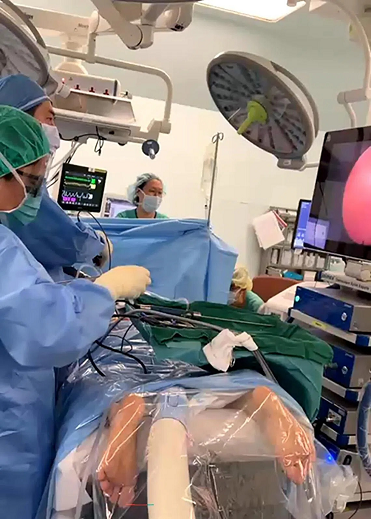
Retired precision engineer Teo Seow Heong, 75, was awake throughout the two-hour spinal procedure. PHOTO: NNI
Patients are mobile within hours rather than days, with about two in five patients going home on the day of their operation itself – cutting the hospital stay and costs.
Tan said the procedure has shifted from a niche alternative to a mainstream standard of care, particularly for seniors and high-risk patients.
“We have colleagues who do awake brain surgery where patients are awake, talking to the team or playing the violin during the procedure. Now, why can we not do it for spine surgery? We also want to save time and costs for them,” he said.
Tan believes that when a patient is awake, the procedure is safer.
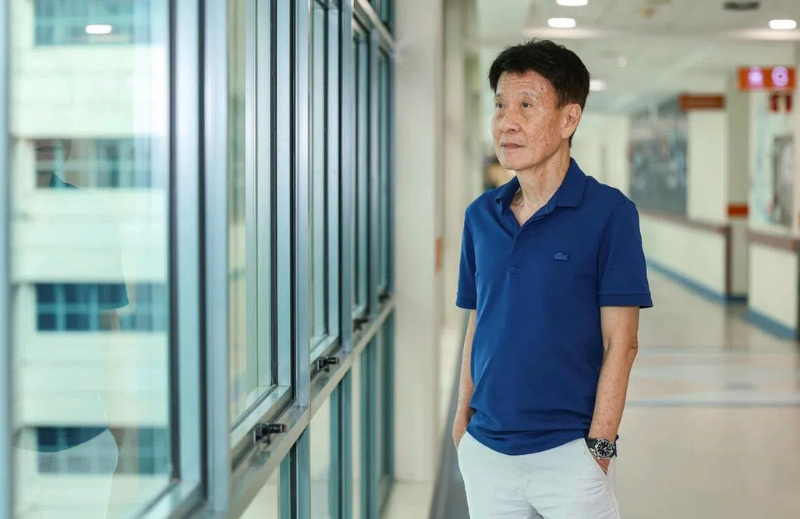
Retired precision engineer Teo Seow Heong was able to return to an active lifestyle after undergoing awake endoscopic spine surgery. ST PHOTO: BRIAN TEO
“When the patient is awake, I get live monitoring instead of (monitoring) that is delayed. With live monitoring, I would be able to slow down to prevent unnecessary injury,” he said.
The procedure is a growing trend at NNI, in cooperation with NHG Health. They started with a single surgeon and an anaesthetist in 2024.
The team has steadily expanded over the past two years, Tan said.
Today, the programme involves NNI and multiple spine surgeons and more anaesthetists across institutions in the NHG Health cluster, which includes Tan Tock Seng, Khoo Teck Puat, Woodlands and Yishun Community hospitals.
There were 25 awake endoscopic spine operations carried out in 2024 by NNI and NHG Health, when they began to perform such procedures. The number grew to 40 in 2025.
So far in 2026, 80 operations have been done by NNI and NHG Health.
The procedure is also performed across the National University Health System under the National University Spine Institute, and at the SingHealth Duke-NUS Spine Centre.
“As more teams gain experience and collaborate across institutions, awake spine surgery is becoming an increasingly established option for carefully selected patients,” Tan said.
Oh added: “The less complex cases like slipped discs will benefit from awake spine surgery. The surgeon goes in there like a sniper, shaves off the disc and it’s done.”
However, spine conditions like fractures and neck injuries and those involving large spinal procedures, such as scoliosis or curvature of the spine, cannot be treated with the procedure because they often require prolonged operation times and complex manipulation of a highly unstable spine.
Keeping a patient under local anaesthesia during such invasive trauma repair poses high safety risks, the two doctors said.
Teo’s procedure in 2025 was an awake uniportal left-sided bilateral lumbar 4/5 decompression, where the bone and tissue were shaved off, relieving pressure on pinched nerves. It took about two hours.
After the operation, he was up and about, walking without pain, and could return home before the end of the day.
Today, Teo is back to jogging in the evenings and practising taiji.
“The wound was so small, I sometimes even forget I had a spine operation. I am grateful to the team for giving me back my life,” he said.





















 HealthXchange
 Health Videos


